What is Merino Wool? - A complete guide to natures wonder fibre.
Quick guide
-
What is Merino wool?
-
Where does Merino wool come from?
-
The British heritage story
-
Merino wool as a fleece
-
Merino vs Polyester fleece
-
Key benefits of Merino wool
-
FAQs
What is Merino Wool?
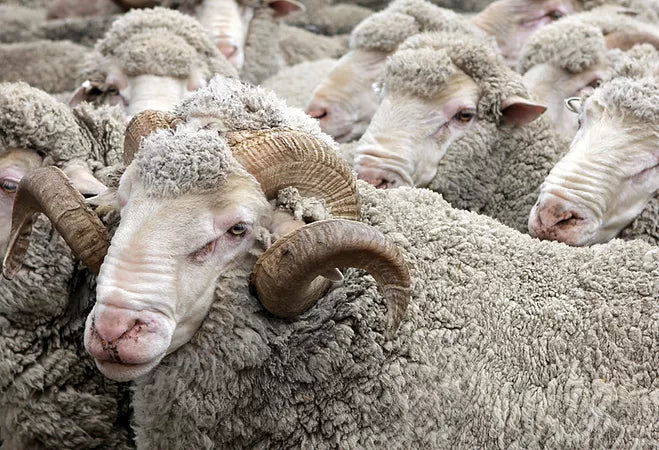
Where does Merino wool come from?
Nothing else feels like Merino wool, looks like Merino wool, or wears like Merino wool.The Woolmark Company
The British heritage story of Merino
Ask most merino wool brands where the story begins, and they will point you to Australia. That is where it ends up - but it is emphatically not where the story starts. The real origin of the Australian merino industry is British, and the hands that built it, transported it and transformed it into cloth were Yorkshire hands.
1780's
King George III smuggles merino out of Spain
Fascinated by agriculture and desperate to establish a British fine-wool industry, King George III quietly deployed agents to smuggle merino sheep out of Spain over more than a decade. The Spanish monopoly was one of the most jealously guarded in Europe — but by the 1780s, a small royal flock was established in Britain.
1797
British naval officers carry the first flock to Australia
Captain Henry Waterhouse and Lieutenant William Kent, officers of the Royal Navy, transport 26 merino sheep from the Cape of Good Hope to Port Jackson, New South Wales. More than half perish on the voyage. The survivors become the founding flock of what will become the world's greatest wool industry. The animals were acquired for just £4 per head — a footnote that belies their eventual worth to a nation.
1807
The Reverend Samuel Marsden and the first bale
The Reverend Samuel Marsden - born in Farsley, West Yorkshire, educated at Cambridge - sends the first bale of Australian wool to England for commercial sale. He was himself a pioneer of merino breeding in Australia, and in 1809 was gifted five Spanish merino sheep by King George III to take back with him to New South Wales. A man of the cloth, in every sense.
1808
Yorkshire mills process the first Australian clip
That first bale is processed at William Thompson's mill at Rawdon, near Leeds - stored in a warehouse in Farsley before being turned into cloth. The loop was complete: British colonial enterprise had seeded the Australian merino industry, and Australian merino was now feeding the Yorkshire mills. This symbiosis would define global textile production for the next two centuries.
1837
Abraham Moon & Sons is founded in Guiseley, Yorkshire
The same year Queen Victoria ascends to the throne, Abraham Moon establishes his cloth business in Guiseley - a mill town on the northern fringes of Leeds. He begins by supplying yarn to families who weave on hand looms in their homes. The business grows into one of the greatest woollen mills in England.
Today
One of the last vertical mills in Britain
Abraham Moon & Sons in Guiseley remains one of the very last fully vertical woollen mills in Great Britain - taking merino fibre all the way from raw bale through dyeing, blending, carding, spinning, weaving and finishing, entirely on one site. Their clients have included Burberry, Paul Smith, Ralph Lauren, J.Crew and now Woolf.
Why Merino wool makes a better fleece than polyester

Merino wool vs polyester fleece: a full comparison
| Property | Merino wool | Synthetic fleece |
|---|---|---|
| Thermal regulation |
Active - responds to body temperature
|
Passive - insulates only
|
| Warmth when wet |
Retains up to 80% of insulation when damp
|
Loses most insulation value when wet
|
| Odour resistance |
Natural lanolin prevents bacterial growth
|
Synthetic fibres harbour odour-causing bacteria
|
| Moisture management |
Absorbs up to 30% of own weight, stays dry to touch
|
Wicks surface moisture but doesn't absorb
|
| Microplastic shedding |
Zero - a natural protein fibre
|
Sheds hundreds of thousands of plastic particles during wear and washing
|
| Biodegradability |
Fully biodegradable - breaks down naturally within 6 months to a year
|
Persists in environment for 200+ years
|
| Wrinkle resistance |
Natural crimp structure prevents creasing
|
Generally wrinkle resistant
|
| Wash frequency needed |
Rarely - odour resistant, spot-clean or air out
|
Frequently - holds odour, requires regular washing
|
| Feel against skin |
Soft at fine micron counts (under 22μm)
|
Feels soft
|
| Renewable source |
Grown annually by sheep
|
Derived from petroleum
|
Key benefits of Merino wool
Thermo - Regulating
Cooling
Warming
Odour Resistant
Itch free
Washable
Quick Drying
Wrinkle Resistant
Durable
Non Allergenic
Water Resistant
Fire Resistant
FAQs
No. Standard wool fibres measure around 35 microns and can irritate skin. PureFleece® uses 20 micron Merino Lambswool, fine enough that the fibres bend on contact rather than prickle. Most people who think they can't wear wool find merino a completely different experience.
It comes down to fibre diameter. Standard wool typically measures 30 microns or more, which is stiff enough to prick the skin. Merino measures under 24 microns, and our PureFleece® is 20 microns, fine enough to bend rather than irritate. Merino also outperforms standard wool on moisture-wicking, odour resistance and temperature regulation.
Primarily from Australia, with a smaller proportion from farms in the South African highlands. Every source is fully vetted, the herds are raised under the Five Freedoms, and our merino is mulesing-free. Each batch carries Official Woolmark Certification.
Yes. Merino sheep grow a new fleece every year, making wool a fully renewable resource. Unlike synthetic fabrics, merino is biodegradable rather than persisting in landfill and shedding microplastics. It also needs far fewer washes than cotton or synthetics, which reduces water and energy use over its lifetime.
Generally, yes. Merino's ultra-fine fibres bend on contact with skin rather than pricking it, which is what causes irritation with coarser wools. Research has shown that fine merino worn next to the skin doesn't aggravate eczema, and can help regulate skin temperature and moisture, two common triggers for flare-ups. If you have a known wool allergy, speak to a dermatologist before wearing any wool product.
No. The same crimp structure that traps warm air in winter lets heat and moisture escape when it's warmer. PureFleece® breathes comfortably up to around 20°C, which is why we treat it as a three-season fabric rather than a winter-only one.
Contact form